Operations of Drones/UAVs
Drones, also known as Remotely Piloted Aircraft Systems (RPAS) or Unmanned Aerial Vehicles (UAVs), are regulated federally by Transport Canada. Because drones share airspace with crewed aircraft, specific rules apply depending on the weight of the aircraft, the location, and the nature of the operation, particularly when operating near airports or other aviation facilities.
The airspace surrounding the North Bay Jack Garland Airport (YYB) includes controlled airspace, a hospital helipad, and a water aerodrome. Operators are responsible for understanding the airspace classification and operational requirements for their specific location. Advisory tools, such as the Drone Site Selection Tool provided by the National Research Council Canada (NRC), may assist operators in identifying controlled or restricted airspace and nearby aviation facilities.
Drones 250 grams and over
Drone operations involving aircraft weighing 250 grams or more are subject to Transport Canada regulations under the Canadian Aviation Regulations (CARs), Part IX. Depending on the operation and location, operators may be required to:
- Hold a valid Transport Canada Drone Pilot Certificate (Basic or Advanced), or where applicable, a Special Flight Operations Certificate (SFOC)
- Register and mark the drone with Transport Canada
- If operating a drone in controlled airspace, authorization from NAV CANADA is required and can be requested through the NAV Drone app.
Drone operations conducted on airport-controlled lands, including take-off or landing from airport property, must be coordinated with the North Bay Jack Garland Airport Corporation. This requirement applies only to operations occurring on airport property and does not apply to drone operations elsewhere in the city.
Micro-drones (under 250 grams)
Micro-drones weighing less than 250 grams do not require registration or a pilot certificate. However, micro-drone operators must still comply with federal aviation law. All drones are considered aircraft under the Aeronautics Act and Canadian Aviation Regulations, and are therefore prohibited to enter restricted airspace without permission.
To fly any drone at an advertised event, including a drone weighing less than 250 g (a microdrone), you must get a Special Operations Certificate (SFOC) for Remotely Piloted Aircraft Systems (RPAS).
Micro-drone operators must comply with Transport Canada’s Rules and Best Practices and must not operate a drone in a manner that could endanger people or property.

NAV CANADA – NAV Drone App
NAV Drone is a mobile application from NAV CANADA that helps drone operators fly safely and legally in Canada’s controlled airspace.
➡️ Using the app, operators can:
- Review applicable drone safety guidelines
- Check where drone operations are permitted
- Submit flight requests and schedule operations
- Receive authorization decisions directly from NAV CANADA
NAV Drone is recommended for operators seeking authorization to fly drones in controlled airspace near YYB.

Use of Airspace Authorization Application
Regardless of size all drone/UAV operators must have approval from NAV Canada to operate within the 15NM controlled airspace around the North Bay Jack Garland Airport.
Authorization requests can be submitted through NAV CANADA, or through the NAV Drone mobile app,
➡️ For more information visit Transport Canada Drone Safety.
All registrations, licensing, assessments/reviews, and approvals are conducted by Transport Canada.
Safety, Enforcement & Compliance
- Unauthorized or unsafe drone use may result in fines of up to $3,000
- If you witness illegal or unsafe drone activity near the airport, contact local law enforcement or 911
- Operators are responsible for understanding and complying with all applicable rules before flying
To assist with flight planning and identifying restricted areas, operators may use the NRC UAV Site Selection Tool.
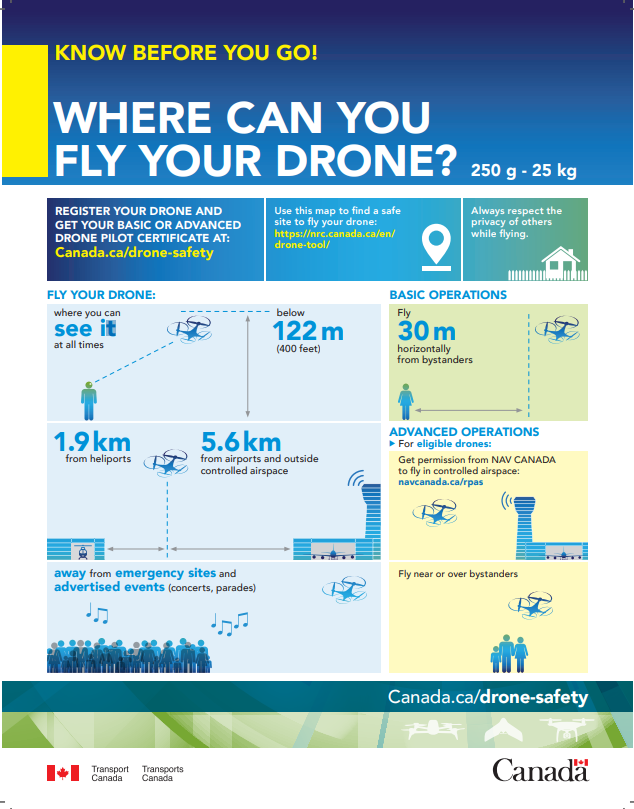
➡️ For a visual overview of drone flight restrictions and safety considerations, download the Drone Safety Poster.